
If you visit ten different airports across Europe and look at how their runways and taxiways are lit, you will likely find ten different approaches. Some airports use elevated lights almost everywhere. Others rely heavily on in-pavement (inset) fittings. Many use a mix of both, sometimes on the same runway.
The interesting thing is that there is no single rule that tells an airport exactly which type to install. ICAO Annex 14 and the Aerodrome Design Manual (Doc 9157, Part 4) define the photometric and chromaticity requirements that lights must meet, and they describe both inset and elevated options. But the choice between one and the other is, in most cases, left to the airport operator, the design engineer, and the local civil aviation authority.
So what drives the decision? It comes down to a handful of very practical factors: cost, visibility, maintenance, exposure to traffic, snow operations, and the specific location of each light on the airfield. This article walks through each of those factors and looks at how airports around the world approach the question differently.
A Quick Definition
Before going further, it is worth being clear about what we mean by each type.
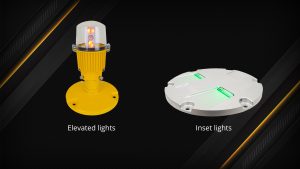
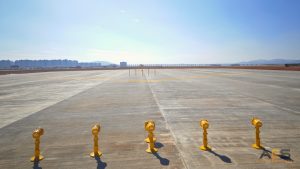
Elevated lights are fittings mounted above the pavement surface, typically on frangible couplings or posts. They stand anywhere from a few centimetres to around 35 cm above the surface, depending on the application. Common examples include taxiway edge lights (blue), runway edge lights (white/yellow), and some runway guard lights (flashing yellow).
Inset lights (also called in-pavement or flush-mounted lights) are installed into the pavement surface so that only the top of the fitting is visible. They sit almost level with the surrounding surface, with a very low protrusion, designed to withstand the direct passage of aircraft wheels and ground vehicles. Examples include taxiway centreline lights (green), runway centreline lights (white/red), touchdown zone lights, and stop bar lights.
Both types must meet the same photometric standards defined by ICAO, FAA, or EASA for their specific application. The light output, colour, and beam characteristics are not optional regardless of the mounting style.
The Case for Elevated Lights
Cost
Elevated fittings are generally less expensive to install than inset lights. The reason is straightforward: installing an inset light means cutting into the pavement, preparing a base, ensuring proper drainage, and sealing the fitting flush with the surface. An elevated light, by contrast, requires a base plate or a frangible coupling bolted to the pavement surface. The civil works are simpler and faster, which brings the total installation cost down.
For airports with limited budgets, or for airfields that are being lit for the first time (such as regional or military aerodromes), elevated lights can be the more practical option.
Visibility
Elevated lights tend to be more visible to pilots, particularly at longer distances and lower approach angles. Because the light source sits above the pavement plane, it is less likely to be obscured by surface water, rubber deposits, or minor undulations in the pavement. This is one reason why runway edge lights and taxiway edge lights are almost always elevated: they need to be seen from a wide range of angles and distances.
Maintenance
From a maintenance standpoint, elevated lights are generally easier to access. A technician can inspect, clean, or replace an elevated fitting without needing to work inside the pavement. For lamp or LED module changes, the fitting can usually be serviced from above. Inset lights, by contrast, require the technician to work at ground level with the fitting recessed into the surface, and in some cases the entire optic assembly needs to be removed for access.
That said, the maintenance story is more nuanced than it appears at first glance, as we will see below.
The Case for Inset Lights
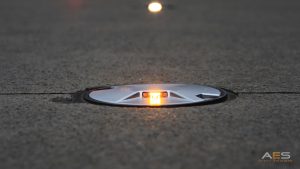
Inset lights exist for a very specific reason: they need to survive in areas where elevated fittings would be damaged or destroyed.
Traffic Exposure and Runway Intersections
The most obvious scenario is any location where aircraft wheels or nose gear may roll directly over the light. This includes runway centrelines, touchdown zones, taxiway centrelines, and critically, runway/taxiway intersections.
At a runway exit or intersection, aircraft regularly pass over the lighting line as they transition from the runway to a taxiway. An elevated fitting in that location would be struck repeatedly by mainwheel or nosegear tyres, and no amount of frangibility would make that sustainable. This is why ICAO and virtually every national standard requires centreline and intersection lights to be inset.
For a vivid example of what happens when aircraft regularly hit elevated objects on the pavement, consider the well-documented issue of runway centreline light damage at high-traffic airports. Maintenance logs at busy hubs consistently show that even inset centreline lights take significant punishment from tyre impacts, rubber buildup, and the sheer weight of heavy aircraft rolling over them. An elevated fitting in the same position would not last a single day of operations.
Snow Removal Operations
This is one of the most practical and often overlooked factors in the inset vs elevated debate, and it deserves its own section.
The Snow Factor
At airports in northern Europe, snow removal is not an occasional event. It is a core operational activity that can happen multiple times a day during winter months.
Runway and taxiway snow removal is typically done using a convoy of vehicles: snowplows with wide blades go first, followed by rotary brooms, and then blowers. The entire operation is a precisely choreographed sequence designed to clear the runway as fast as possible.
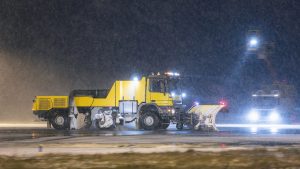
Here is where the choice between inset and elevated becomes very real.
Inset lights sit flush with the pavement. A snowplows blade can pass directly over them without risk of collision. The rubber or polyurethane blades that airports use on the airside are designed to ride just above the surface, and inset fittings simply disappear beneath them. This makes snow clearing faster, simpler, and less likely to result in damaged equipment.
Elevated lights, on the other hand, protrude above the surface. Snowplows operators need to be careful around them, which can slow down operations. Elevated lights on taxiway edges can and do get clipped by plow blades, especially during heavy storms when visibility for the plow operator is limited.
However, there is a counterargument that is worth mentioning. Halogen elevated lights generate heat when operating. That heat can help melt snow and ice that accumulates around the fitting, keeping the light visible without manual cleaning. This is one reason why some airports in extremely cold climates have historically preferred halogen elevated fittings over LED for certain applications: the «waste heat» of the halogen lamp actually serves a useful purpose. With LED fittings, which run much cooler, airports in these climates may need to consider heated lens options or more frequent manual cleaning.
AES Airport Solutions: Inset and Elevated, Full Range
AES Airport Solutions supplies both inset and elevated airfield lighting from the Airsafe range, covering runway, taxiway, approach, and signage applications. All products are certified to ICAO, FAA, and EASA standards.
Whether you are designing a new installation from scratch or upgrading an existing system, we can help you specify the right combination of inset and elevated fittings for your specific operational context, climate, and traffic profile.
Have a project in mind? Contact our team and we will be happy to discuss it.