Pits & Converters
Airport pit systems and ground power units for efficient aircraft turnaround. AES Airport Solutions now supplies a complete range of electrical and air conditioning pit systems alongside diesel ground power units (DGPU) for aircraft power supply. Designed for apron and gate operations at civil and military airports, these products help reduce turnaround times, lower operating costs, and keep ground infrastructure compact and reliable.
All Products
Airport Pit Systems
Pit systems are the ground-level infrastructure that delivers electrical power and air conditioning to parked aircraft directly from below the apron surface. Instead of relying on external mobile equipment that takes up space and creates obstacles around the aircraft, a pit system keeps everything underground until it is needed.
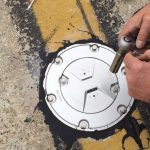
AES offers two main configurations. The hatch pit system uses a simple, mechanically operated cover that opens to give ground crews access to the power and air conditioning connections below. It has a stable and reliable structure with very few moving parts, which translates into a low failure rate and reduced maintenance costs. The compact design requires less excavation and civil works during installation, making it a practical choice for airports looking to minimise construction disruption on active aprons.
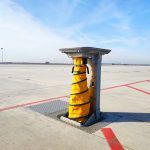
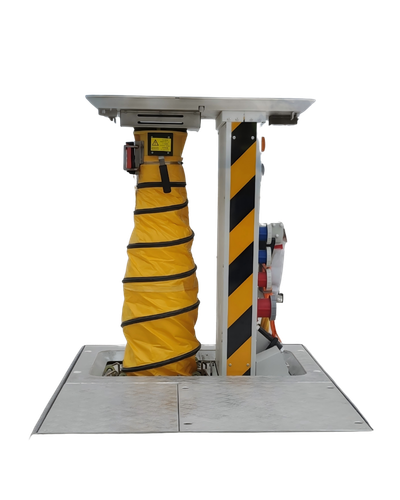
The pop-up pit system takes a different approach. The entire service column rises out of the ground when needed, giving crews easy access to connections at a comfortable working height. The electrical pop-up version can accommodate up to four 400 Hz power supplies, while the air conditioning pop-up version handles up to two hoses. Once the aircraft departs, the column retracts below the surface, leaving the apron clear for the next operation.
Both configurations are compliant with EN124 F900, the European standard for load-bearing covers in areas subject to heavy vehicle and aircraft traffic.
Electrical Pit System Configuration
The electrical pit systems supplied by AES support a range of power configurations tailored to the needs of different aircraft types and gate setups. Available options include 115 V, 90 to 180 kVA, 400 Hz power supply for aircraft systems, 50/60 Hz maintenance power supply for ground equipment, and 28/270 V DC power supply for engine starting and avionics. The 400 Hz output can be configured with 1 to 4 channels depending on the gate requirements.
Cable management is handled through either gravity-based coiled cable storage or electrically driven flexible cable storage, depending on the installation. All pit systems include a safety interlock function that immediately cuts off the power supply if an abnormal electrical connection or pit cover status is detected, protecting both the aircraft and the ground crew.
Air Conditioning Pit System Configuration
The air conditioning pit systems deliver pre-conditioned air to the aircraft cabin while it is parked at the gate, reducing the need to run the aircraft’s own auxiliary power unit (APU). This saves fuel, reduces emissions and noise on the apron, and lowers operating costs for the airline.
The system uses spring-reinforced air conditioning hoses that are strong and durable enough for daily use in an airport environment. An air conditioning controller can manage up to 8 units, and hoses can be extended or retracted either manually or automatically. The system also includes electric valves, open dampers, and automatic condensate collection and discharge.
Diesel Ground Power Units (DGPU)
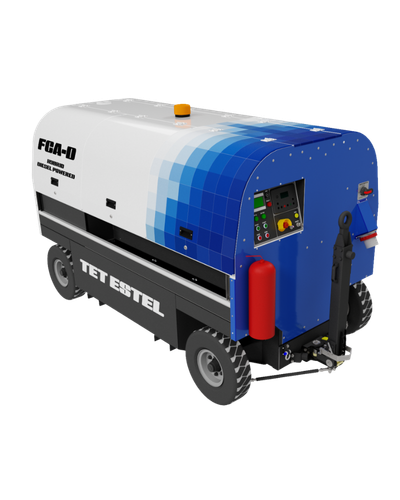
Alongside the fixed pit systems, AES supplies mobile diesel ground power units manufactured by TET Estel AS, a European manufacturer based in Tallinn, Estonia, with a long track record in aircraft ground power equipment.
The DGPU range currently includes two models. The FCA-90 delivers 90 kVA of 400 Hz power through a single output, paired with a 28 VDC / 600 A rectifier module for engine starting. The FCA-180 doubles the capacity to 180 kVA through two 90 kVA outputs, also paired with a 28 VDC / 600 A module. Both units are powered by Cummins diesel engines and can also operate in static mode from an external 3×400 V, 50 Hz grid connection.
These are serious machines built for demanding airport environments. The FCA-90 weighs up to 3,000 kg and carries 2 x 150 litres of fuel. The FCA-180 goes up to 4,000 kg with 2 x 300 litres. Both operate in temperatures from -40°C to +40°C, carry IP55 protection on the converter module, and comply with DFS 400, ISO 6858, MIL-704E, SAE ARP 5015, and multiple EN standards for electromagnetic compatibility and safety.
The voltage and frequency regulation on these units is exceptionally tight: frequency stabilisation accuracy of 0.1% and voltage regulation accuracy of 0.5%, with total harmonic distortion below 2%. That level of precision is what aircraft electrical systems require, and it is what sets a purpose-built DGPU apart from a generic industrial generator.
Other Products