
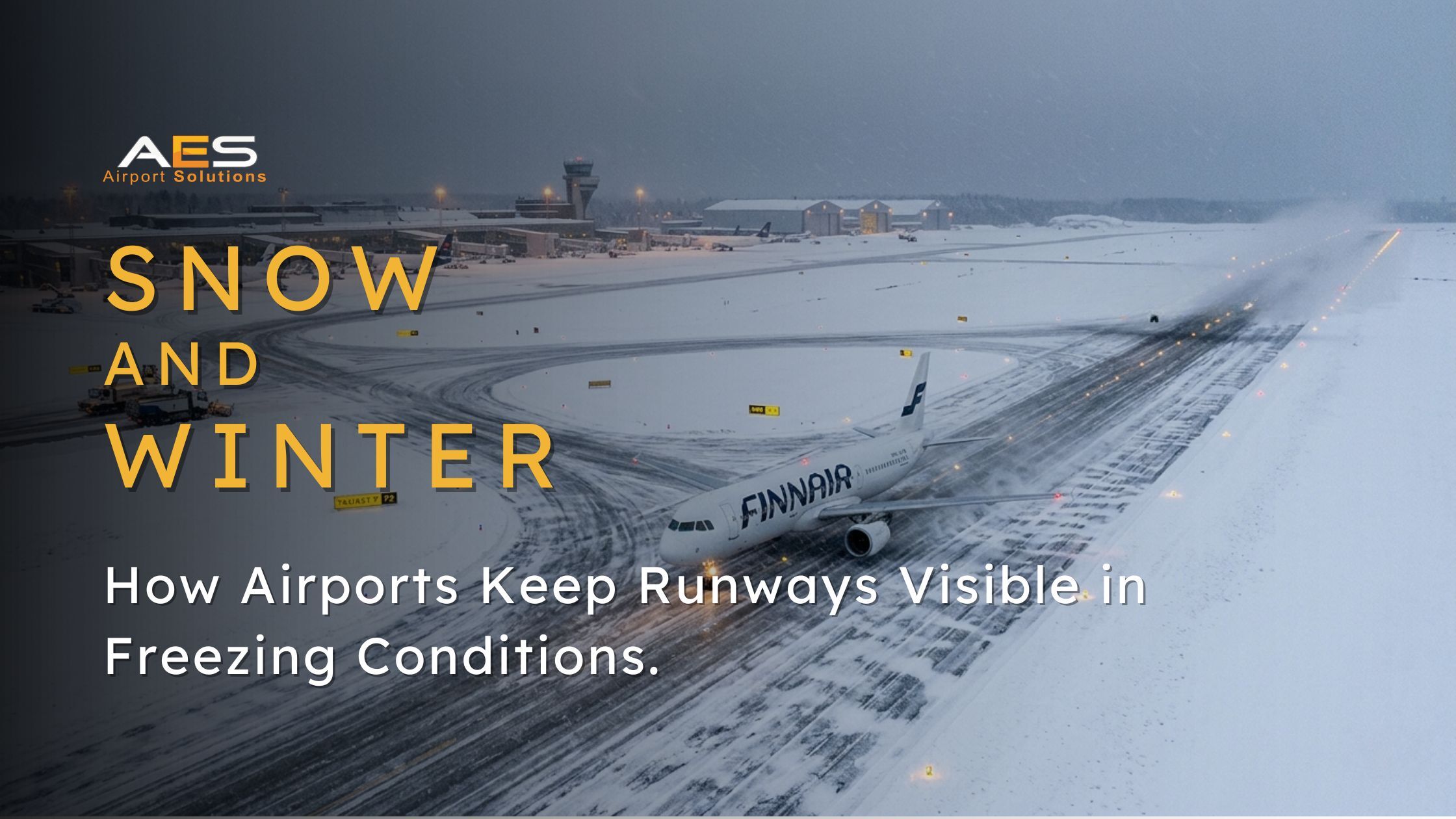
Airfield Lights in Snow and Winter Conditions
Winter is the season that tests every component of an airfield ground lighting system. Snow covers lenses, ice forms around fittings, snowplough blades pass centimetres away from elevated lights, and de-icing chemicals eat into hardware that was never designed to deal with them. Meanwhile, the airport needs to stay open, flights need to land, and every single light on the runway and taxiway system needs to be visible.
For airports in northern Europe, Scandinavia, Canada, Alaska, northern Japan, and the mountain regions of central Asia, this is not a once-a-year problem. It is a daily operational reality that lasts for months. And it has a direct impact on the choice, design, and maintenance of airfield ground lighting.
This article looks at the challenges snow and ice create for AGL systems, how modern technology addresses those challenges, and what airport operators should consider when specifying lighting for cold-weather environments.
The Problem: What Snow and Ice Do to Airfield Lights
The fundamental issue is simple. Snow and ice accumulate on the optical surfaces of airfield lights, blocking or reducing the light output that pilots depend on for safe navigation. But the details of how that happens, and the consequences when it does, are more complex than they might seem.
Lens Obstruction
The most immediate risk is physical obstruction of the lens. When snow falls on an elevated light, it can cover the glass or polycarbonate lens partially or completely, reducing the candela output that reaches the pilot. For inset lights, snow accumulates on the flush surface and can fill the slight recess around the fitting. In both cases, the light may still be powered and functioning, but the pilot cannot see it.
ICAO and national regulators set minimum serviceability thresholds for airfield lighting, typically requiring 90% or more of fittings to be operational for the runway to maintain its approach category. «Operational» means visible, not just switched on. A light buried under snow is effectively a failed light as far as the pilot is concerned.
Ice Formation
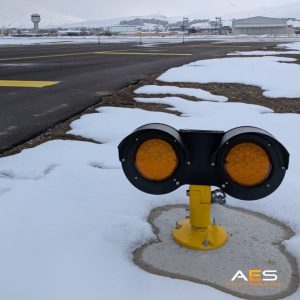
Ice is in many ways more problematic than snow. Snow can be brushed or ploughed away. Ice bonds to the surface and is much harder to remove without risking damage to the fitting. On inset lights, water can accumulate in the slight gap between the fitting and the surrounding pavement, freeze, and form a layer of opaque ice directly over the prism or lens. On elevated lights, freezing rain or freezing fog can coat the entire optical surface in a thin layer of clear ice that is almost invisible to maintenance crews but significantly reduces light transmission.
Rubber and Chemical Deposits Combined with Snow
On busy runways, the lenses of inset lights accumulate rubber deposits from aircraft tyres over time. In winter, these rubber-covered lenses attract and hold snow and ice more readily than clean glass would. The combination of contamination and winter precipitation creates a compounding visibility problem that requires more frequent cleaning cycles.
De-icing chemicals applied to the runway surface can also affect AGL fittings. Glycol-based and acetate-based de-icers are not chemically neutral. Over time, they can degrade seals, corrode metal hardware (particularly if it is not stainless steel), and leave residues on optical surfaces that further reduce light transmission.
Snow Bank Obstruction
After snowplough operations, cleared snow is pushed to the sides of the runway and taxiway, forming snow banks. If these banks are allowed to build up too high or too close to the lighting line, they can physically block the beam path of elevated lights, making them invisible from certain approach angles. FAA Advisory Circular AC 150/5200-30D provides detailed guidance on snow bank height limits along runways and taxiways specifically to prevent this problem (source: FAA AC 150/5200-30D).
The Halogen Advantage That LED Had to Solve
For decades, airports in cold climates had a built-in solution to snow and ice on light lenses: heat.
Halogen and incandescent airfield lights are inherently inefficient at converting electricity into light. A large proportion of the energy they consume is released as heat. That «waste heat» turned out to be genuinely useful in winter. A halogen runway edge light running at full intensity generates enough heat to melt snow and thin layers of ice from its lens, keeping itself visible without any additional systems.

When the industry began transitioning to LED, this natural self-cleaning effect disappeared. LED fittings are far more energy efficient, which means they run much cooler. A typical LED airfield light simply does not generate enough heat to prevent snow or ice accumulation on its lens. The FAA acknowledged this directly in its research, noting that while LEDs offer significant energy and maintenance benefits, an extra heater or other modification may be needed to replicate the snow-melting capability of halogen lamps (source: FAA, «Light-Emitting Diodes in Airfield Lighting Applications»).
This is where the arctic kit comes in.
Arctic Kits: Giving LED Lights the Ability to Fight Snow and Ice
An arctic kit is a thermostatically controlled electric heating element integrated into the light fitting. Its job is to raise the temperature of the lens or prism area enough to melt snow and ice, keeping the optical surface clear.
The concept is straightforward: a small heater, typically consuming less than 12 VA of additional power, is built into or added to the fitting. A thermostat activates the heater when the ambient temperature drops below a set threshold and deactivates it when it rises above. The result is a behaviour similar to the natural heat output of a traditional halogen lamp, but in a controlled, energy-efficient way.
How Arctic Kits Work in Inset Lights
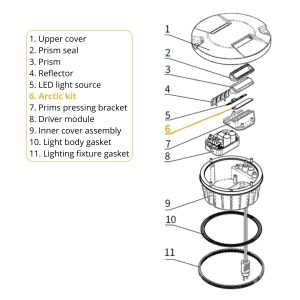
For inset (in-pavement) fittings, the arctic kit typically heats the area near the prism assembly.
Since inset lights sit flush with the pavement surface, snow and ice tend to accumulate right on top of the optical surface. The heating element raises the temperature of the prism and surrounding area just enough to melt anything that settles on it.
How Arctic Kits Work in Elevated Lights
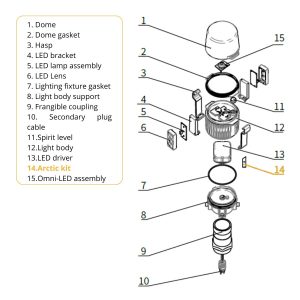 For elevated fittings, the arctic kit heats the external glass lens. This prevents ice from forming on the outer surface and melts snow as it lands. Some manufacturers use conductive coatings applied directly to the glass lens, allowing the lens itself to act as the heating element. This approach heats the glass directly rather than indirectly, which is more energy efficient because glass has low thermal conductivity and heating it from behind wastes energy warming the air inside the fitting rather than the lens surface.
Snow Removal and Its Impact on AGL
Even with arctic kits and heated lenses, snow removal operations remain the primary tool for keeping airfield surfaces clear. And those operations have a direct impact on the AGL system.
Snowplough Blade Damage
Snowploughs operating on runways and taxiways use wide blades (often 5 to 7 metres across) to clear snow as quickly as possible. The blades are typically fitted with rubber or polyurethane edges on the airside to reduce the risk of damaging in-pavement fittings and pavement markings. Despite this, elevated lights that protrude above the surface are at risk of being clipped, especially during heavy snowfall when visibility for the plough operator is reduced.
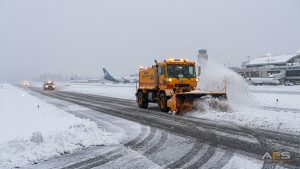
This is one of the reasons why the choice between inset and elevated lights matters so much at airports with significant winter operations. Inset lights sit flush with the pavement, allowing plough blades to pass directly over them. Elevated lights require plough operators to navigate carefully around them, which slows operations and increases the risk of accidental contact.
De-icing Chemical Exposure
Runway de-icing chemicals (typically potassium acetate, sodium acetate, or urea-based products) are applied after ploughing to prevent ice reformation. These chemicals can be corrosive to certain metals and materials. AGL fittings used in airports with heavy chemical de-icing programmes should use stainless steel hardware and corrosion-resistant sealing materials to withstand repeated exposure over many winter seasons.
Practical Considerations for Airports in Cold Climates
For airport operators and engineers specifying AGL systems for cold-weather environments, there are several practical factors worth considering.
LED vs Halogen: The Trade-Off Is Not Always Clear
The industry trend is firmly towards LED, and for good reason: longer life, lower energy consumption, better colour consistency, and reduced maintenance. But for airports in extreme cold climates, the halogen lamp’s natural heat output still has a functional role. Some airports deliberately retain halogen fittings for certain applications (particularly elevated edge lights) specifically because they self-clear in snow.
The decision should be made on a case-by-case basis. If LED is the choice (as it increasingly is), ensure the fittings include a certified arctic kit or heated lens option and that the additional power draw is factored into the CCR and circuit design.
Inset vs Elevated in Winter Environments
We have covered this topic in detail in a separate article, but the winter dimension is worth repeating here. Inset lights are inherently better protected from snowplough damage. Elevated lights are more visible from distance and naturally shed snow more easily due to their shape and angle. Many cold-weather airports use a combination: inset centreline and intersection lights, elevated edge lights with arctic kits.
Maintenance Programmes for Winter
Winter maintenance of AGL goes beyond lamp replacement. It includes regular cleaning of optical surfaces to remove rubber deposits and chemical residues before winter starts, monitoring lens clarity and light output after each snowfall event, checking seal integrity on inset fittings to prevent water ingress and subsequent ice formation, verifying arctic kit functionality and thermostat calibration before the season begins, and coordinating with snow removal teams to minimise AGL damage during clearing operations.
A good winter AGL maintenance programme starts before the first snowflake falls. Pre-season preparation is far more effective than reactive repairs in the middle of January.
Signage Visibility in Snow
It is not just lights that get obscured in winter. LED taxiway guidance signs can also be partially or fully covered by blown snow or spray from ploughing operations. Signs positioned close to the ground are particularly vulnerable. FAA AC 150/5200-30D specifically notes that visibility of signs and lights should be maintained by prescribed clearing techniques or by performing post-clearing maintenance (source: FAA AC 150/5200-30D).
AES Airport Solutions: AGL for All Climates
AES Airport Solutions supplies the full Airsafe range of runway, taxiway, and approach lighting, including fittings designed for harsh winter environments. Our products are available with arctic kit options and are built with materials and sealing standards that withstand the demands of cold-climate operations.
Whether you are specifying a new installation for an airport in Scandinavia, upgrading an existing system in the Alps, or looking for guidance on how to configure your AGL for winter resilience, get in touch with our team. We have experience supporting projects across a wide range of climatic conditions and are happy to help.
📩 aes@aes-europe.com 📞 +376 665 572