
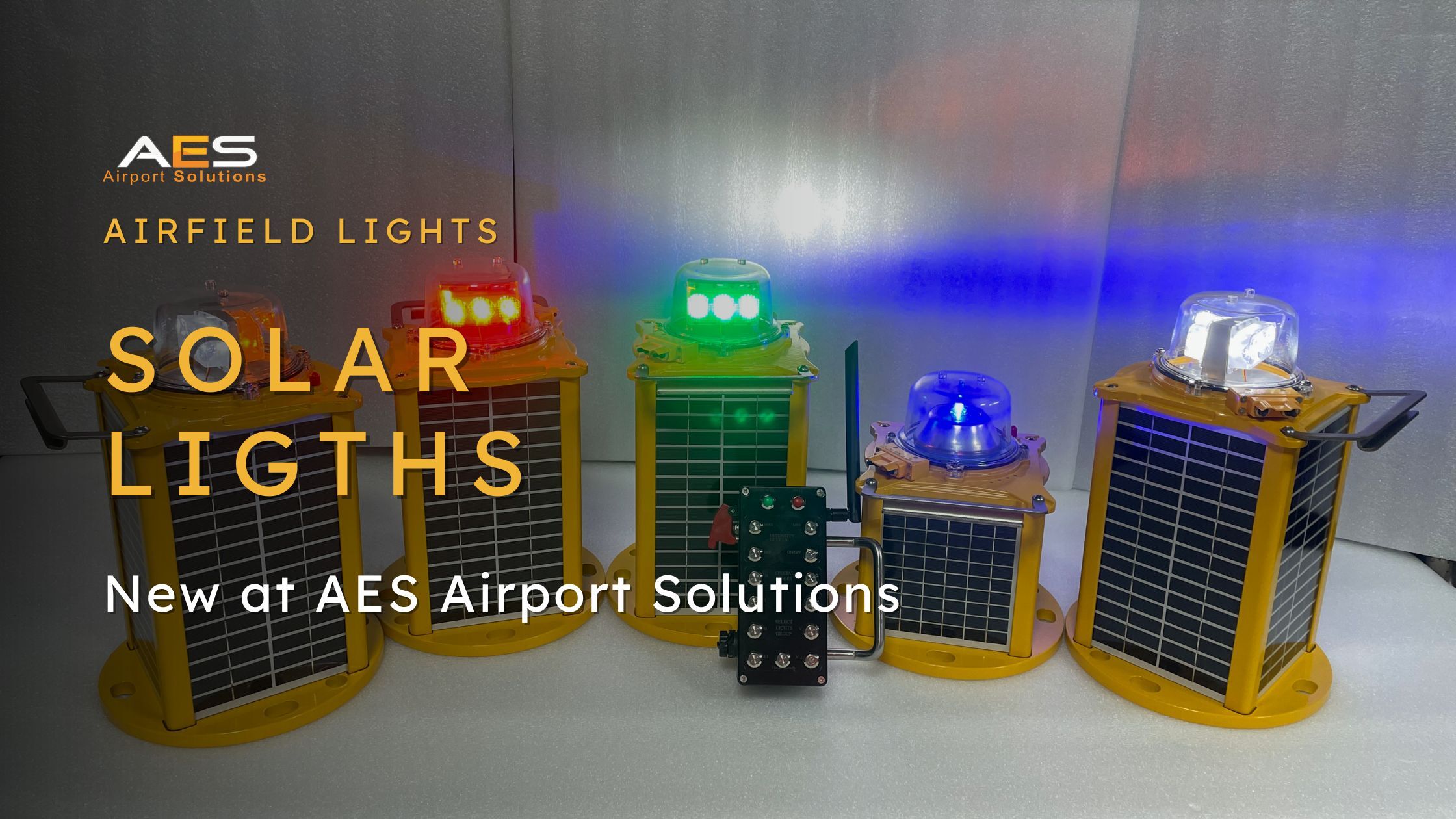
We are expanding our product catalogue with a new range of solar-powered airfield lights. From today, AES Airport Solutions supplies a complete line of solar AGL fittings designed for runways, taxiways, aprons, approach and temporary airfield operations, covering both civil and military applications.
The new range complements our existing portfolio of hard-wired Airsafe systems and opens up a set of applications where running cables is impractical, too expensive, or simply not possible. This article walks through what the range includes, what it is built for, and why we think it is going to be a very useful option for a lot of airport operators.
Why Solar Airfield Lights?
Traditional AGL systems rely on a network of underground cables, isolation transformers, and constant current regulators. That infrastructure works brilliantly for established airports, but it comes with a catch: installation requires trenching, civil works, and a permanent connection to the grid.
There are plenty of situations where that approach does not fit. Remote airfields without reliable grid access. Temporary runway closures where lights need to be redeployed elsewhere for a few weeks or months. Military operations where speed of deployment matters more than anything else. Helipads in locations where pulling cables would cost more than the lights themselves. Emergency deployments after natural disasters or during humanitarian missions.
Solar airfield lights are designed for exactly these scenarios. No trenching. No cabling. No grid connection. Place the unit on the ground, switch it on, and it works.
What the Range Includes
The AES solar AGL range covers two main product families, both available in multiple colour and configuration options.
AES-AL-X Series: Low Intensity Omni-Directional Solar Lights
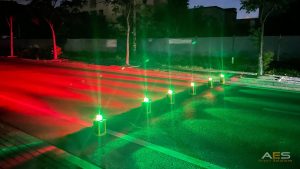
The omni-directional unit is designed for applications where the light needs to be visible from multiple angles. Typical uses include runway edge lights, taxiway edge lights, threshold lights and final approach and take-off areas (FATO).
Available colours include blue and red, allowing the same unit to cover virtually every application where an omni-directional fitting is required.
Some key specifications are worth highlighting. The fitting is compliant with ICAO Annex 14 Vol. I, FAA AC 150/5345-46F, and IEC TS 61827. It uses a 3.6V/13AH lithium battery that delivers over 80 hours of autonomy, and 12V/2.5W solar panel. Ingress protection is IP66. LED source life is rated at over 100,000 hours.
AES-AL-X Series: High Intensity Solar Portable Airfield Lights
The high intensity portable range is the workhorse of the line. It is built for runway edge, runway end, threshold, and threshold/end applications where higher photometric output is required. These are the units that can stand in for a full hard-wired runway lighting system in temporary or off-grid deployments.
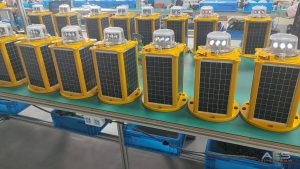
Available configurations cover white, white/yellow, red, green, and green/red colour combinations, matching standard runway edge, threshold, and end light requirements under ICAO Annex 14 Vol. I and FAA AC 150/5345-46F.
The specifications are designed to handle real operational conditions. The lithium battery delivers over 30 hours of autonomy in unidirectional mode, or 20 hours in bidirectional mode, on a single charge. The unit is wind resistant up to 240 km/h, operates between -40°C and +55°C, and carries IP66 ingress protection. LED life exceeds 100,000 hours.
Features That Make a Difference
Beyond the raw specifications, there are several design details that set these units apart for real-world use.
The solar panel is fully integrated into the light body, rather than externally mounted, covering all four faces of the fixture. This keeps the unit compact, reduces Foreign Object Debris (FOD) risk on operational areas, and makes handling much simpler.
Wireless remote control is an option across the range. A single controller can operate multiple lights at distances of up to 5 km, manage up to five independent light groups, switch between steady and flashing modes, and apply three levels of dimming during operation. For military or specialised applications, an NVG (Night Vision Goggle) compatible mode is also available, including an infrared lighting option.
The fittings use efficient drive circuits and thermal management systems to protect the LEDs and extend operational life, and include built-in surge protection and sealed power supplies for reliable operation in harsh environments.
Available with an integrated solar panel, a charger, or both options, offering flexibility to meet different project requirements.
The Charger Storage Box (AES-CSB)
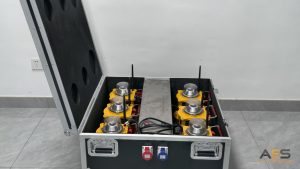
One of the accessories worth mentioning separately is the integrated charger storage box. It is a rugged transport case with wheels and handles that can charge up to six lights simultaneously via AC (220V/50Hz) or DC (15-24V) input.
For military deployments, disaster relief operations, or any scenario where a set of portable lights needs to be moved, charged, and deployed quickly, the charger storage box turns the solar lighting set into a genuinely turnkey solution. The upper cover is grooved for stacking multiple boxes, which helps keep logistics manageable when you are moving several sets at once.
Typical Applications
The solar AGL range is designed for a wide variety of use cases:
Permanent installations at remote or rural airfields where grid connection is unavailable or unreliable. Temporary runway closures where lights need to be redeployed on a secondary runway or displaced threshold. Military airfields requiring rapid deployment, NVG compatibility, and easy redeployment. Emergency response and humanitarian operations. Flight schools and general aviation airfields looking for cost-effective lighting solutions.
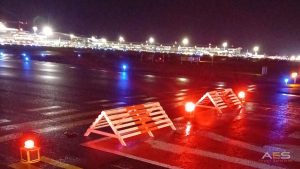
AES has already supplied solar airfield lights for projects across Europe, including our recent solar airfield lights deployment at Dublin Airport for the Runway 16-34 closure along with the taxiways during site construction works. That project is a good example of how solar AGL fits into the broader operational picture of an international airport.
Complementing the Existing AES Range
The solar range does not replace our hard-wired Airsafe AGL products, it complements them. For permanent installations at established airports, the classic solution of runway lighting, taxiway lighting, and approach lighting powered by constant current regulators remains the standard.
What the solar range adds is flexibility. It lets airport operators, engineering firms, and defence customers cover scenarios that were previously difficult to address, without having to source from a different supplier. For us, it means we can now offer a complete AGL proposition that covers the full spectrum of use cases, from the most permanent to the most temporary.
Want to Know More?
If you have a project in mind, whether it is a permanent off-grid airfield, a temporary closure, a helipad, or a military deployment, get in touch with our team. We will be happy to discuss your requirements, share the full technical documentation, and put together a proposal that fits what you actually need.
📩 aes@aes-europe.com 📞 +376 665 572