
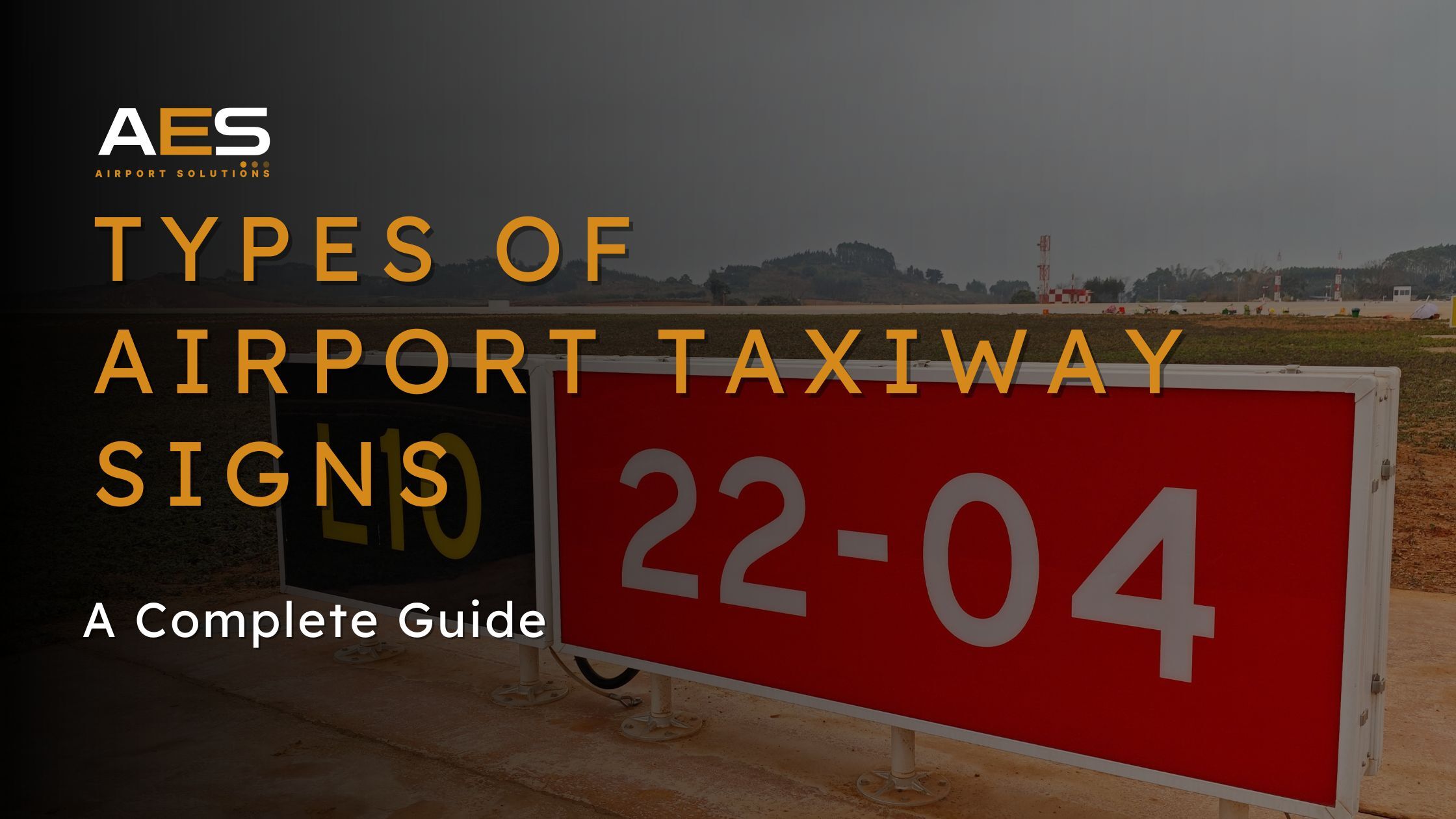
If you have ever walked across an airport apron or watched a cockpit camera feed, you have probably noticed the colourful signs lining the taxiways. Red backgrounds, yellow backgrounds, black inscriptions. They might look straightforward at first glance, but each sign serves a very specific purpose and follows strict international standards.
For airport operators, engineers and maintenance teams, understanding these signs is not just helpful. It is essential. A misplaced or poorly maintained sign can create confusion during ground movements, and in aviation, confusion on the ground is something nobody wants.
This guide breaks down the six types of taxiway guidance signs defined by ICAO Annex 14 and explains what each one communicates, how to identify it, and why proper maintenance matters.
1. Mandatory Instruction Signs
Appearance: White text or symbols on a red background.
Mandatory signs are exactly what the name suggests. Pilots must follow them. These signs mark critical boundaries that an aircraft should not cross without explicit clearance from Air Traffic Control (ATC).
The most common examples include runway designation signs placed at runway holding positions. When a pilot sees a white «09-27» on a red background, it means: stop here, you are about to enter a runway.
Other mandatory signs include NO ENTRY markings, which prevent aircraft from taxiing into restricted or one-way areas.
These signs are positioned at the holding position itself, on the left side of the taxiway in the direction of movement. Because they protect runway incursion boundaries, they are arguably the most safety-critical signs on the entire airfield.
Key identification tip: If the background is red, the instruction is mandatory. No exceptions.

2. Location Signs
Appearance: Yellow text on a black background, with a yellow border.
Location signs tell pilots where they are right now. Think of them as street name signs for taxiways. A sign reading «A» with yellow lettering on black background tells the pilot: you are currently on Taxiway Alpha.
These signs are typically placed along the taxiway edge and are especially useful at complex airports where multiple taxiways intersect. Without clear location signs, pilots navigating an unfamiliar airport would struggle to confirm their position relative to ATC instructions.
Location signs are also placed alongside mandatory signs at runway holding positions, so that pilots can confirm both which taxiway they are on and which runway they are approaching.
Key identification tip: Black background with yellow border means «you are here.»

3. Direction Signs
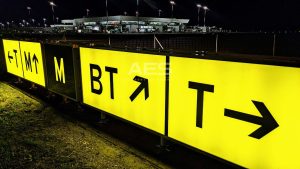
Appearance: Black text on a yellow background, with arrows indicating the turn direction.
Direction signs point the way. They are installed at taxiway intersections to show pilots which way to turn for a specific taxiway. The arrow on the sign indicates the direction of the turn, and the letter or number identifies the taxiway.
For example, a sign showing «B» with a left arrow on a yellow background means: turn left to reach Taxiway Bravo.
When multiple direction signs are grouped together at a single intersection, they are arranged from left to right in the same order as the taxiways they point to. This spatial logic helps pilots quickly scan and identify their intended route.
Key identification tip: Yellow background with arrows. It answers the question «where do I go from here?»
4. Destination Signs
Appearance: Black text on a yellow background, with arrows. Similar to direction signs but showing broader destinations.
Destination signs also use the yellow background and arrow format, but instead of pointing to specific taxiways, they guide aircraft toward larger areas of the airport. Common destinations include terminal buildings, cargo areas, aprons, fuel stations, military ramps, or specific runway thresholds.
You will typically see abbreviations like «APRON,» «MIL» (military), «FUEL,» or specific runway numbers followed by an arrow.
These signs are particularly useful at large airports where taxiing from one area to another involves multiple turns and several minutes of ground movement. Without destination signs, pilots would need to memorise complex taxi routes or rely entirely on progressive taxi instructions from ATC.
Key identification tip: Yellow background with broader location names rather than single taxiway letters.

5. Information Signs
Appearance: Black text on a yellow background. No arrows.
Information signs provide supplementary data that does not fit neatly into the other categories. They might indicate specific procedures, noise abatement areas, radio frequency changes, or other operational notes relevant to ground movement.
These are less common than the other sign types and tend to appear at airports with specific local procedures. Their content varies significantly from one airfield to another.
Key identification tip: Yellow background, no arrows, and the content gives you operational information rather than navigation guidance.

6. Distance Remaining Signs
Appearance: White numbers on a black background. No border.
These signs are found along runways rather than taxiways, but they are part of the same signage family and worth including for completeness. They show the remaining runway distance available in thousands of metres (or thousands of feet, depending on the region).
A sign showing «3» means 3,000 metres of runway remain. These signs are placed at regular intervals along the runway edge, typically every 300 metres or 1,000 feet.
For pilots during takeoff and landing rolls, distance remaining signs provide a quick visual reference to assess stopping distance. For airport operators and maintenance crews, keeping these signs clearly visible and properly illuminated is a direct contribution to operational safety.
Key identification tip: Simple white number on black background, positioned along the runway edge.
Why LED Technology Matters for Taxiway Signs
Traditional taxiway signs used incandescent or fluorescent lighting, which brought well-known challenges: frequent lamp replacements, higher energy consumption, and reduced visibility in certain weather conditions.
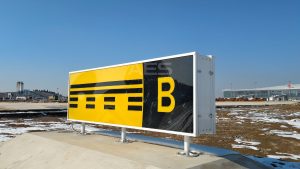
Modern LED taxiway guidance signs address all three issues. LEDs offer significantly longer operational life, lower power consumption, and consistent brightness that holds up well in fog, rain, and low-visibility conditions.
At AES Airport Solutions, our taxiway guidance sign range covers all six sign types in LED configurations. The signs are built to meet ICAO Annex 14, FAA AC 150/5345-44 and EASA standards, and they are designed for straightforward maintenance with modular components that can be replaced without removing the entire sign housing.
A recent example is the Erfurt-Weimar Airport project, where 64 LED taxiway guidance signs were installed covering mandatory, location and direction types. The result was a complete modernisation of the airfield signage system with improved visibility and reduced maintenance requirements.
Real-World Application: Reading Signs During Taxi
To put this into context, imagine an aircraft that has just landed on Runway 09 and needs to taxi to the terminal.
After exiting the runway, the pilot first sees a mandatory sign (red background) confirming they have cleared the active runway. Next to it, a location sign (black background, yellow border) confirms they are now on Taxiway Charlie.
At the next intersection, a direction sign (yellow background, arrow) points left toward Taxiway Alpha. The pilot follows ATC instructions and turns left.
Further along, a destination sign (yellow background, «TERMINAL» with arrow) confirms they are heading the right way.
Each sign provides one clear piece of information. Together, they create a logical chain that guides the aircraft safely from runway to gate.
Maintenance Considerations for Airport Operators
Taxiway signs are exposed to jet blast, weather, UV radiation, and the occasional vehicle impact. Over time, sign faces can fade, housings can corrode, and internal illumination can degrade.
ICAO Annex 14 recommends regular inspections to ensure that all signs remain legible and properly illuminated. This includes checking for:
- Faded or damaged sign faces
- Failed or flickering illumination
- Obstructed signs (vegetation, snow, equipment)
- Correct positioning after any taxiway modification
- Reflectivity and colour accuracy
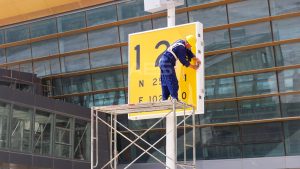
LED signs reduce some of these maintenance burdens thanks to their longer lifespan and lower heat generation, but they still require periodic inspection. A well-maintained signage system is a direct investment in ground safety.
If you are planning a signage upgrade or need to replace ageing incandescent signs with LED alternatives, our team can help you determine the right configuration for your airfield layout. Contact AES Airport Solutions to discuss your project requirements.
Frequently Asked Questions
What are the different types of airport taxiway signs? There are six types of taxiway guidance signs defined by ICAO Annex 14: mandatory instruction signs, location signs, direction signs, destination signs, information signs, and distance remaining signs. Each type uses a specific colour combination for quick identification.
What does a red airport taxiway sign mean? A red background on an airport sign indicates a mandatory instruction. These signs are placed at critical boundaries such as runway holding positions, and pilots must not proceed beyond them without ATC clearance. White text on a red background is the standard format.
What is the difference between location and direction taxiway signs? Location signs (yellow text on black background with yellow border) tell pilots which taxiway they are currently on. Direction signs (black text on yellow background with arrows) show which way to turn to reach another taxiway. Location says «you are here» while direction says «go this way.»
Are airport taxiway signs the same worldwide? ICAO Annex 14 establishes the international standards for taxiway signage, including colour codes, placement and content. Most commercial airports worldwide follow these standards, which means the colour code system is consistent across ICAO-compliant airfields.
Why are airports switching to LED taxiway signs? LED taxiway signs offer longer operational life, lower energy consumption, and better visibility in adverse weather compared to traditional incandescent or fluorescent signs. They also reduce maintenance frequency, which lowers long-term operating costs for airport operators.
How often should taxiway signs be inspected? ICAO recommends regular inspections of all airfield signage to ensure legibility and proper illumination. The exact frequency depends on traffic volume, climate conditions and local regulations. Most airports include signage checks as part of routine airfield maintenance programmes.